Tag: News (Page 5 of 5)

Two of BioWare’s Founders Are Leaving the Company

Today Bioware Co-Founders Greg Zeschuk and Ray Muzyka announced that they are leaving the company, and possibly video games in general.

Both have made statements on their departure via their blogs, that basically express their interest in moving on to other ventures. Muzyka provides a vague idea of his interests moving forward saying:

“I believe strongly in the power of free enterprise to enable sustainable change, so my next ‘chapter’ will likely focus on an entirely new industry, something exciting, different and frankly downright scary – investing in and mentoring new entrepreneurs, and more specifically, the field of social/impact investing.”

Zeschuk provides a clearer idea of his life moving forward, as he expresses the usual interest of his desire to spend more time with his family along with the more specific desire to get into the craft beer industry:

“The main project I will be working on is a web-based interview show called The Beer Diaries where I interview notable brewers and showcase their beers. If things go well, I’ll work on other beer-related shows, apps and projects.”

The most telling, and somewhat disheartening, statement provided by either man would belong to Zeschuk who also said:

“I’ve reached an unexpected point in my life where I no longer have the passion that I once did for the company, for the games, and for the challenge of creation.”

Greg Zeschuk and Ray Muzyka both got into the video game industry after graduating medical school at the University of Alberta. They worked on medical based computer programs before that same passion for gaming led them, and co-founder, Augustine Yip, to create their first title “Shattered Steel” for publisher Interplay. From that point they spearheaded a studio that’s game catalogue reads like the upper end of most best video games of all time lists. Bioware has revolutionized Western and PC RPGs with “Baldur’s Gate,” made one of the all time great cult classics in “MDK2,” crafted the greatest “Star Wars” game of all time (and one of the most important games period) in “Knights of the Old Republic,” and just recently have made two of the best series of this generation with “Dragon Age” and “Mass Effect.”

More important than any individual contributions, however, are the greater ideas that Zeschuk and Muzyka promoted with Bioware. Through several generations, they helped run a studio that always advanced the RPG genre with each new entry (and gaming as a whole in most cases) and proved yet again that maintaining artistic integrity and achieving financial success are not mutually exclusive in the business. While the departure of Zeschuk and Mzyka doesn’t mean Bioware will no longer achieve those same goals, it is sad to realize that even such legends in the industry can simply lose their passion and walk away.

Of course, like Neil Young said, “Sometimes it’s better to burn out, than to fade away.” Zeschuk and Muzyka leave behind an undisputed legacy that future generations of developers can only hope to duplicate, but should most certainly learn to appreciate. Here’s hoping them the best in the future.

Also, Greg, I’ll buy a case of Baldur’s Beer, or Icewind Ale should they hit store shelves.

Obsidian Announces Project Eternity

It hard not to think of Obsidian as the “little brother” of the video game world.

While made up of competent and experienced developers, the company itself often piggybacks off of the successes of big brother development companies like Bethesda and Bioware, with titles such as “KOTOR:II” (someone remind me to do something about how much I hate that game…), “Fallout: New Vegas,” “Dungeon Siege III,” and “Neverwinter Nights 2.” While they’ve proven they have the ability to take the ball and run with it, they’ve yet to come up with something impressive of their own doing.

Of course if there’s one advantage to riding on the shoulders of RPG giants, it’s that you gain a real great lay of the land.

Which is why it’s so exciting that the company has announced a new independent Kickstarter project under the name “Project Eternity.”  From what is known about the game, it looks to bring back the classic, western, isometric perspective RPG genre, complete with the traditional party based, paused combat system seen in some of the Bioware classics of yore. If you really want an idea of how much inspiration Obsidian is drawing for this title, you only have to look at their own description, which lays some serious hype on the game:

“‘Project Eternity’ will take the central hero, memorable companions and the epic exploration of ‘Baldur’s Gate,’ add in the fun, intense combat and dungeon diving of ‘Icewind Dale,’ and tie it all together with the emotional writing and mature thematic exploration of ‘Planescape: Torment.'”

If you’ve never played those games (shame on you) then let me assure you that is a tall task even for a group of aforementioned giant riders. It’s certainly an intriguing concept however, especially considering that the concepts presented in those games mentioned have influenced the RPG genre as much as any others, and this style of title hasn’t been done well in a long, long time. Throw in the fact that much of the Obsidian development team worked on some of those titles mentioned, and maybe you can understand why it’s time for classic RPG fans to start getting excited.

Obviously, when you’re trying to get people to throw money at something that you’d really like to do (which, by the way, quite a few people are already doing) there is an understandable tendency to exaggerate. That being said, though, I’m such a big fan of those style of games that I still want to see how close they can get to fulfilling their promise, and I’m willing to put aside my seething, blinding hatred of “KOTOR: II” to give Obsidian the chance to also prove themselves worthy as developers of independent properties.

Besides, this is the same company that’s managing to make a “South Park” video game look unbelievably incredible. So I wouldn’t dare tell them there isn’t anything they can’t do.

Video Game’s Dream Away Team

In case you haven’t been to Google lately, we’re currently celebrating the 46th anniversary of “Star Trek.”

Of course, providing the influence for one of the more entertaining and complete Google Doodles in some time is pretty far down on the lists of long term accomplishments for the classic series. Of those, one of the greatest has to be the cast of characters assembled on the show, which is such a motley combination of personalities that debates on favorites still, sadly, wage on with frightening ferocity to this day.

Of course many of those same fans have also wondered how they and their friends would fare as part of a space crew. The sad truth is, many of us would likely destroy the craft after getting hammered on that mysterious blue alcohol stuff and start randomly flipping switches while making the traditional sound effects.

The world of video games, however, is filled with capable crew members. In fact, I can think of a few that would I even trust enough to helm the U.S.S. Enterprise itself.

Captain: Nathan Drake

You could say that Nathan Drake’s lack of the “official” captain rank, as well as his inexperience with the finer points of space travel would make him a questionable candidate. However, as Captain Kirk himself taught us all, the real qualities of a captain lie in his fearless nature, magnetic personality, ability to seduce women of all varieties, and flawless fist fighting skills. Nathan Drake has all of this in spades, and no matter what the job (he was once the man who climbed a wrecked train in the snow with a bullet in him, remember) I have faith that he is the only character capable of leading such a crew.

Red Shirts: Lemmings

The red shirts of “Star Trek” got no love, but without their  countless sacrifices, our heroes of the U.S.S Enterprise would have fallen many times over. Much like those noble crimson clad heroes, lemmings are equipped for a variety of tasks, but their main job in life is dying over and over. The best part is they do it with glee, without a shred of discontent to be found amongst them. When I’m looking for a staff of generic, replaceable, overly loyal crew members to fill my ship with, it has to be the lemmings.

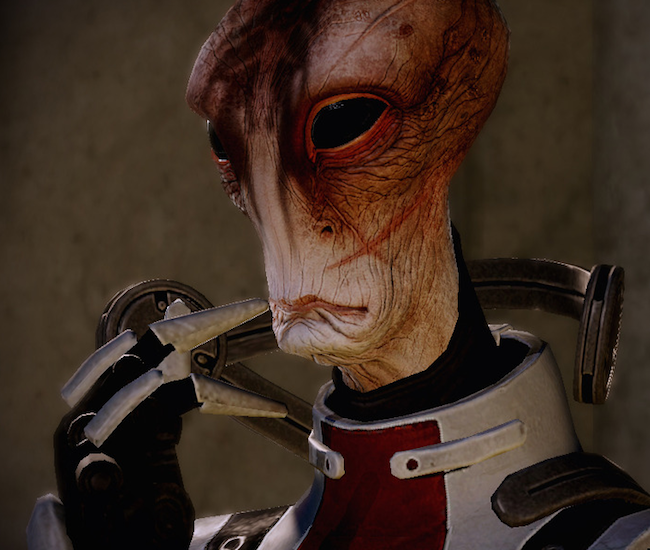
Doctor: Mordin Solus

Ok, so “Mass Effect” is basically the “Star Trek” game we never got, so this is kind of a cheat.  Oddly enough, however, the video game world is not flush with capable, traditional doctors. Mordin Solus can not only heal a broken limb, or cauterize a wound, but his interstellar work experience has given him invaluable experience into dealing with every type of galactic calamity that may arise for a variety of species, while retaining the ability to keep a calm mind not motivated by personal conflict, and instead focused on what is best for all. Combined with his ability to project fire and ice from his bare hands at will, Solus is the only sawbones I want on my video game away team.

Second in Command: Gordon Freeman

He and Solus would have both been great candidates for the number two position on the crew, but Freeman has long proved himself as not just a capable man of science (even though the one experiment we saw him in went horribly, horribly wrong), but a leader of men as well. For reasons never quite explained, Gordon Freeman is a multi-talented, never wavering killing machine that has the ability to quickly decipher a variety of on the fly brain teasing situations. Frankly, he gets it done like no other video game character. While he doesn’t have the personality to lead a crew, he’s a better second in command than anyone can hope for.

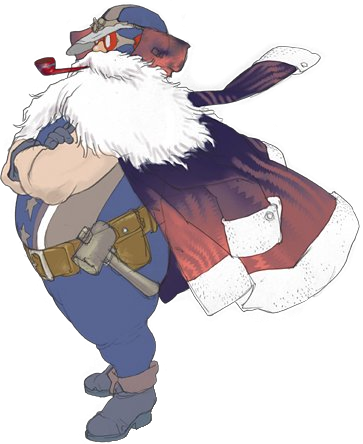
Engineer : Cid Pollendina

There’s been many variations of the Cid character, and while many of them were engineer types, and some people prefer the gruff Cid Highwind from “Final Fantasy VII,” to me the only engineer your team needs is “Final Fantasy IV’s” Cid Pellendina. He’s a little more fun loving than some of the other Cids, yet his work ethic is unwavering, and unlike Cid Highwind, you never have to worry about him falling into a bout of alcoholism, or for his nicotine withdrawals to interfere with his work. Also you can only really trust an engineer with a full beard.

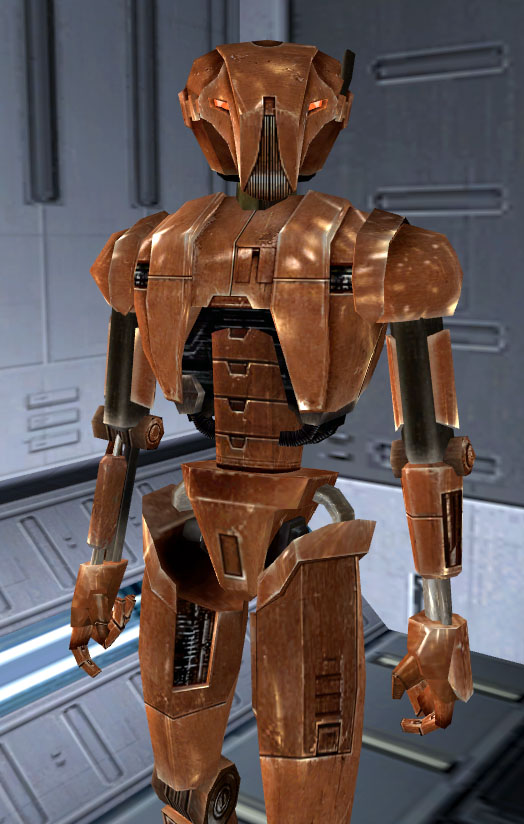
Lieutenant: HK-47

There’s a school of thought that says that a good lieutenant is always learning, fiercely loyal, and ready to step up and take charge at a moments notice. HK-47 has many of those qualities, but only if the mission is killing meatbags. Otherwise this assassin droid has a slight attitude and tendency to question orders, which can tend to discourage all but the most sociopathic of crew morale. However, sometimes you want an officer who is going to question your decisions, yet ultimately follow your final orders with machine like efficiency. HK-47 is that officer.

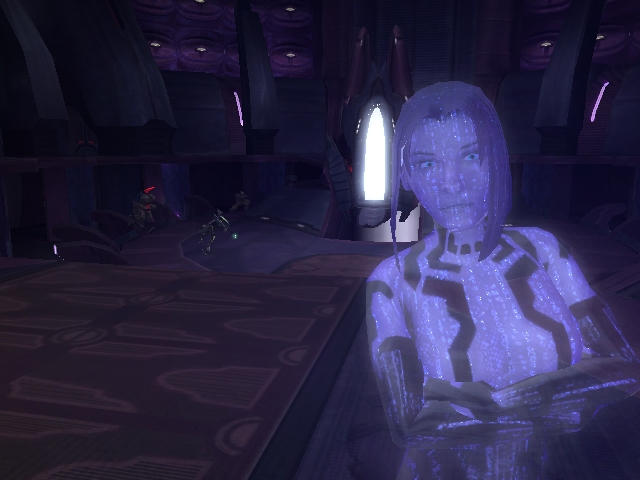
Communications: Cortana

While lacking a physical form, though you wouldn’t believe it due to some creepy fan art out there, Cortana was made for communications duties. A constant source of information, whatever Cortana doesn’t know she can learn. Plus, much like the average smartphone, she can be taken anywhere and is ready to help whenever you need it. While she has lost her virtual mind in the past, making her something of a potential loose cannon, Cortana’s otherwise high level of artificial intelligence and intense loyalty make her the only real candidate for the job.

In any case, she’s much better choice than SHODAN.

The Rise of “Guilds,” and the Fall of “Heroes”

As one MMO flies to incredible new heights, another that once promised players that very feature is coming to an end.

Recently the MMO world was hit with two big bits of news as “Guild Wars 2” developer ArenaNet posted on their Facebook page, that all first party digital downloads of the new mega hit MMO are suspended temporarily in order to insure server stability. While the game is still available through third party sites and retail stores, the developers themselves feel they have a responsibility to everyone in the game to hold off on new sales directly from them, so that play isn’t interrupted. Currently new methods to expand digital services are being looked at.

Hot off the heels of that announcement comes another from the publisher of “Guild Wars 2,” NCsoft, that they will be folding Paragon Studios, and therefore effectively bringing an end to that developer’s MMO title “City of Heroes” by the end of the year.

The reasons for these individual stories of success and untimely demise are both simple and complex, but ultimately revolve around each other.

First, in case you didn’t follow the insane pre-release hype, or immediately snatch up the product that finally launched, “Guild Wars 2” is slowly taking the online world by storm in a way that no other MMO has done since “World of Warcraft” itself. It’s doing this through an incredible art style with a scope and integrity never before seen in a game like this, a PvP system that’s so brilliant and well executed it looks to make all other competitive systems irrelevant by the time it kicks into gear, and maybe best of all, a level of difficulty that rewards players for putting more time into it by actually making the game better as you go along, instead of creating more incentive for new players, and providing cold shoulders for veterans. Tying it all together, unlike “WoW,” “Guild Wars 2” is free to play, continuing one of the more welcome video game trends in some time.

I’ve had the privilege of playing the game recently, and I don’t think I could give you an honest critical review of it. That’s because despite some of its flaws, I have such a deep and abiding respect for the game that questions of review scores and likes or hates are irrelevant. It’s one of those stand up and take notice games that only come along once in a while, even if all of the specifics aren’t perfect.

Oddly though, it seems to achieve such lofts, a sacrifice of sorts had to be made. That seems to be the largest reason behind the cancellation of service for “City of Heroes,” as reports still have the game boasting a sizable player base, and even reporting some respectable sales figures as recently as last year for such an aging title.  However, earlier this year NCsoft reported its first companywide loss in a while, and at the time “City of Heroes” was at the bottom of the sales list. With other ongoing projects to support, and bigger titles on the horizon, it would seem “City of Heroes” fell to the archvillian known as fiscal reports, and nothing more.

Unfortunately it’s not easy to look at this as a case of one door closing and another opening. As good as “Guild Wars 2” is, and as great as it promises to be, “City of Heroes” long stood as the somewhat appropriate icon of hope in the MMO world. It wasn’t a fantasy or sci-fi game, yet it produced a well built and, initially, successful MMO. Now that it has fallen to a, admittedly well worthy, challenger to the “WoW” crown of fantasy MMO dominance, I worry that the message will become more and more clear in developer’s minds that new entrants in the genre are unwelcome, especially if they are trying something different.

In a year’s time I feel that the MMO market will be hotly divided by “Guild Wars 2” players, and by “WoW” addicts, and with good reason. At that time, the mention of a title like “City of Heroes” won’t lead to tears, but rather fond memories. Still, I wish that it were possible for the game to continue in some capacity for as long as it can. Because while the game’s sales figures may have been mild mannered like reporter Clark Kent, beneath the corporate visage of numbers lied an idea of originality, individuality, and innovation in the American way.

Underneath it, lied a true MMO hero.

Blizzard Fumbles Diablo III’s Launch, and the Consequences It Could Have

Although its actual development time was considerably shorter, in the minds of most fans, “Diablo III” has been no less than 12 years in the making. That’s how long it’s been since the release of “Diablo II,” and that’s how long it’s been since gamers have been craving a true follow up. 12 years.

And after just two days of release, some gamers are already more excited about “Diablo IV.”

This is mostly due to Blizzard’s controversial decision to have gamers log-in to its servers in order to play the game. What’s irksome is that it doesn’t matter if you’re playing single player or multiplayer; you have to be online. Ideally, this allows for a range of features that should allow the gamer to be in a constantly networked world where gamers can aid each other in their quest, and friends can drop in at any time to do battle by your side, as you smote your enemies with joyful ease.

In reality though, the servers have been having nothing but trouble since launch. The battle.net network has appeared so far to be insufficiently capable of handling the mass numbers of users “Diablo III” has added without doing that annoying crashing thing and rendering the game unplayable in any form. It’s almost as if Blizzard didn’t anticipate that the sequel to one of the greatest selling and most acclaimed games of all time might actually sell a few copies itself, and that a mandatory online account coupled with that could lead to serious server problems.

Of course, the conclusion that just about everyone who isn’t a Blizzard employee has come to is that the game shouldn’t require a mandatory online account. It’s so ludicrously unnecessary, in fact, that as I was booting up the single player for the first time and it asked me to create an account, I couldn’t help but think of the Kramer line from Seinfeld. “Why does Radioshack need your phone number when you buy batteries?”

Continue reading »

Newer posts »

© 2026 Fearless Gamer

Theme by Anders NorenUp ↑