Category: Editorial (Page 7 of 34)

The 31 Horror Games of October: Part 2

Carrying on from the first part of this series, comes the greatest horror offerings in video game history. If you can squeeze a session with any one of these gems in-between your “Friday the 13th” marathon, or your fifth viewing of “The Thing” this Halloween, you owe it to yourself.
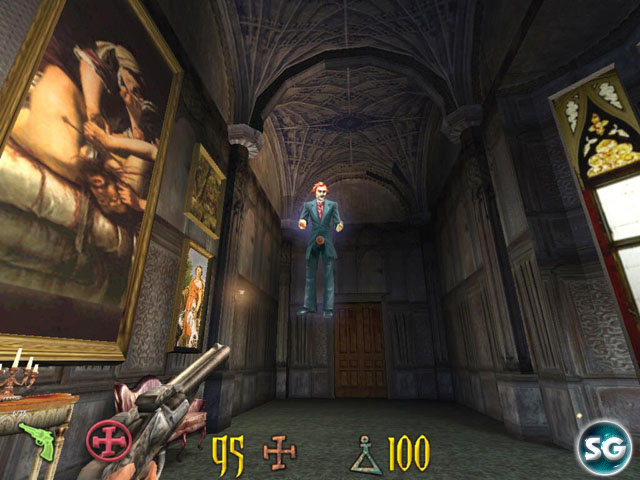
 

19. Clive Barkers Undying – It’s incredible what some great audio design can do for a game. “Clive Barker’s Undying” has a lot going for it (including a great story and a generally unsettling atmosphere), but special props have to be given to the audio which sets the mood so well, it actually generates a bulk of the game’s scares by itself. It takes a hell of an effort for a semi-fast pace  first person shooter to cause the wide variety of scares you get with “Undying,” which is why we’re all lucky that it is a hell of an effort that we got. One of the few games that I wouldn’t mind seeing getting the HD remake treatment, “Undying” seemingly takes glee in how much it scares you.

18. Sweet Home – Until the invention of the internet  “Sweet Home” managed to go unheard of for many in the US, as it was only released for the Famicon in Japan. However, looking back at it now, it’s hard to not admire how ahead of its time the game was. Based off of a movie of the same title being filmed roughly around the same time of the game’s development, “Sweet Home” is a traditional RPG style game that has you investigating a haunted house with a team of five characters (each with their own abilities, naturally). Made by Capcom, it’s pretty easy to see the “Resident Evil” aspects inspired by this one, right down to the slow door openings. What really makes the game memorable is how disturbing it is for an 8-bit title. There is a pretty clear reason this game wasn’t released for the NES at the time, and playing the game now (via available fan translation) is odd because you’re not expecting a game of this era to go out of its way to be so terrifying.

17. Penumbra Series – A huge cult favorite, and a bit of a cheat as this is actually three games, the “Penumbra” series is a good example of ambition exceeding limitations. Initially designed by a team of four people, the “Penumbra” series follows the journey of a man who receives a letter from his supposedly dead father that takes him to the barren, fiercely cold area of northern Greenland. What makes the games so incredible is the use of physics in just about every aspect of the game. As your main survival method is stealth, you have to be aware of your environment at all times to survive. The use of physics based puzzles and combat situations are varied and exceedingly clever, and have rarely been topped since. “Penumbra” falters in parts where combat is forced, and taken as a whole the series is up and down (the third chapter is particularly weak), but you’ll rarely find a more clever game of its type.
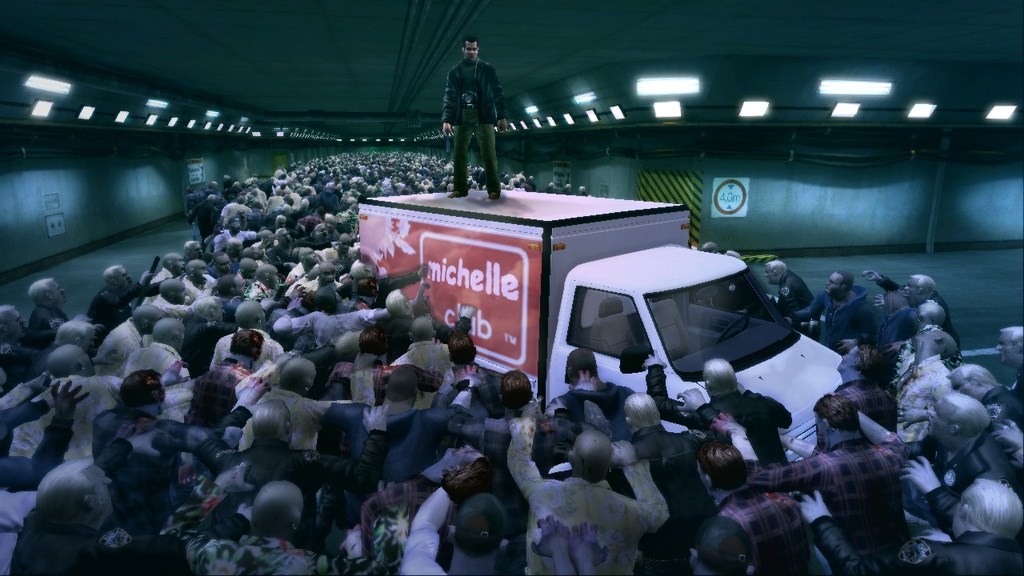
16. Dead Rising– The zombie genre is basically its own animal in the world of video games, but one of the highlights of the undead revolution in games is Capcom’s “Dead Rising.” Anyone who grew up watching “Dawn of the Dead” always wanted to see how they would fare against a mall full of zombies, and Capcom obliged them with this title in 2006. The highlight of the game is the variety of weapons available, as if it isn’t bolted down, it’s probably a weapon. Obviously trips to the hardware store or gun shop are a given, but it’s the more absurd items like giant gumball machines and bowling balls that highlight this playground of destruction. I’m also a fan of the game’s photography system which rewards you for well timed zombie shots, and the game’s creative achievements which are some of the best on the 360. If it weren’t for a truly bad save system and some control issues, I’d have “Dead Rising” far higher.

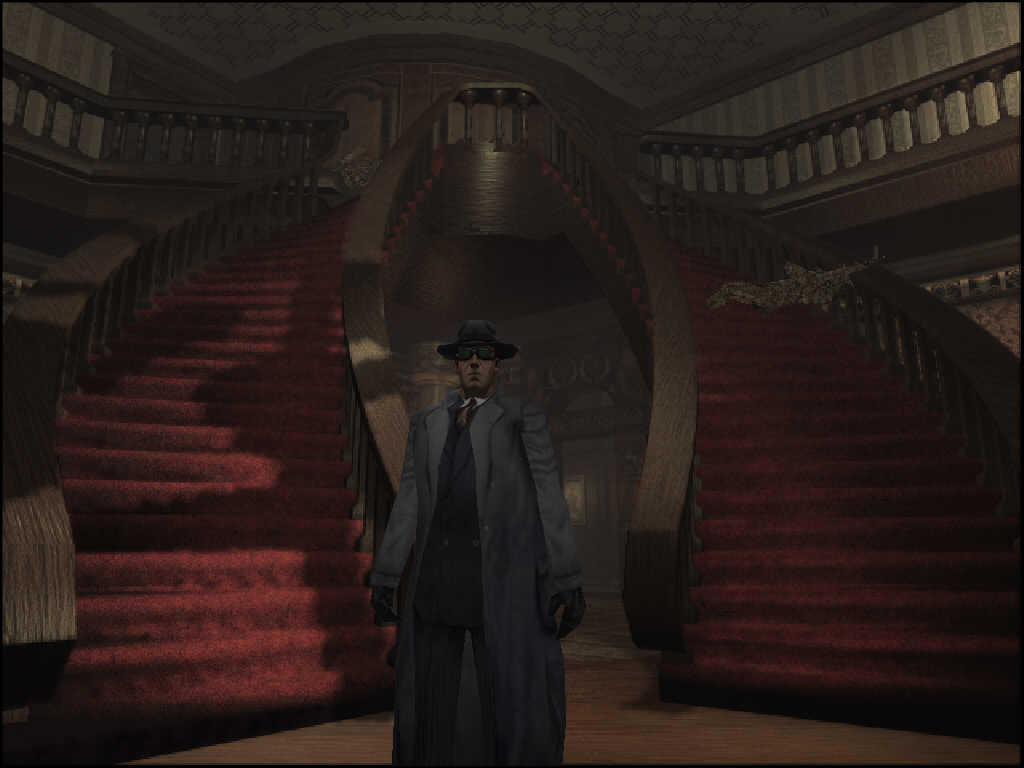
15. The 7th Guest – The game that moved more than 2 million copies and helped to popularize the CD-ROM as a gaming device, the “The 7th Guest” is a classic haunted house horror story that is as important as it is entertaining. A truly bizarre tale involving an eccentric toy maker with haunting visions of dolls, and a mansion where 6 guests are invited under uncertain circumstances, the “The 7th Guest” is a an adventure title in the style of “Myst”. Much like that game, the “The 7th Guest” is filled with mind bending (but rewarding) puzzles that help drive one of the stronger horror narratives in gaming. The somewhat corny acting and graphics are more charming than annoying as you can really appreciate it in a nostalgic type way, and, more importantly, the sense of achievement is still very much alive. If there was a gaming history school, like a film history school, the “7th Guest” would definitely be on the curriculum.

Continue reading »

When Too Many Great Games is a Bad Thing

Fun Fact: There are only three months out of the year.

If you’re saying duh right now, then you must be a major video game developer.

This week brings us the highly anticipated releases of both “XCOM: Enemy Unknown” and “Dishonored.” While two Triple-A incredible games in one week is usually a cause for celebration, it does highlight one of the problems the industry has where the majority of the best games come out sometime between October and December. Like clockwork, it seems that every year the 4th quarter takes our last dollar.

In a way it’s kind of fun as every single week seems to bring us one great game after another, until the holidays roll around and you hope to suddenly get caught up with the gaming blitzkrieg. In another way, though, it’s a principle that really works best for either people in the industry or kids who still make Christmas lists. For the rest of us, it kind of forces you to suddenly have a lot of free time, and a lot of money just to keep up.

It also hurts games like “XCOM”. “Dishonored” and “XCOM” are both amazing titles, but there’s little doubt that between the two “Dishonored” is the much more appealing title for the mass gaming public. A game like “XCOM” that’s a resurrection of a semi-obscure PC franchise, and features a fairly strict learning curve and about a third of the advertising budget of “Dishonored,” has a much harder road to sales success than is necessary for such a stellar game. When you factor in the upcoming releases of sequels to established franchises like “Halo IV” and “Assassin’s Creed III,” you’re looking at snowball’s chance in hell type prospects.

Maybe a game like “XCOM” coming out in July doesn’t guarantee its financial future, but it would be nice to not have to have to choose between two incredible full price games in the same week, only to have to keep doing so throughout the rest of the year.

So would you rather see big releases spread evenly during the year, or are you a fan of the holiday rush?

The 31 Horror Games of October: Part 1

Horror may be gaming’s most effective genre.

While you can put a book down, or tell yourself its just a movie, there is an element of participation involved in games that makes the scary ones that much worse. Even if it is in the virtual sense, you are the one in the game, and the horrors are happening to you.It may have taken a while for developers to truly catch on to the potential of the genre, but ever since there has been a tidal wave of terror that has left many a gamer fumbling their controllers in a cold sweat.

As October rolls around then, and Halloween dawns on us, it is time to celebrate the greatest horror games of all time. I’ve got a list of 31 total, starting here, one for each day of the month. They are loosely ranked, with the main factor being the overall experience.

Although, being absolutely terrifying also doesn’t hurt its standings.

31. Deadly Premonition – Awful graphics, controls, gameplay ideas, acting, and just about every other technical malady you can think of plague this game. But, just like horror movies, not everything has to be perfect for a title to be memorable. There is just something so compelling in the way that “Deadly Premonition” handles itself, as it clumsily (but oddly beautifully) blends horror and black comedy in an open world environment. The game’s story is completely out there, and sucks you in just to see what’s next. It’s almost like the developers intended to make a bad game, but accidentally ended up with something greater than the sum of its parts (much like many a great B-Movie). You’ll either love this game or despise it, but it is impossible to forget, and makes for something every gamer must try even if you hate yourself for doing so.

30. Nocturne – In what will be something of a reoccurring theme on this list, “Nocturne” is brimming with flaws. Sporting one of the worst  cameras ever in a video game, and some equally bad controls to match, “Nocturne” is slightly unplayable these days. But if you gut your way through it you will find some of the best horror environments of all time. Carried by the games great story, “Nocturne” comes off like a mix of the “X-Files” and the old Hammer horror films of the 50s. A technical disaster that did so much else right, this is one game that is begging to be revisited.

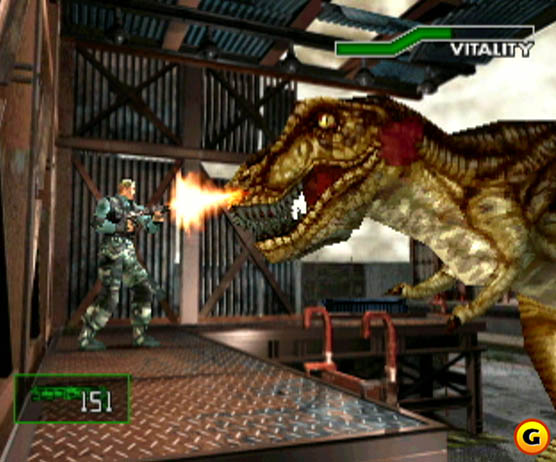
29. Dino Crisis 2 – The first “Dino Crisis” looked and felt a lot like “Resident Evil” with dinosaurs. It was fun, and had moments of genuine creativity, but the series peaked with “Dino Crisis 2.” The survival concept of the first game went almost completely out of the window, and in its place came pure action bliss, as “Dino Crisis 2” became one of the few, and greatest, arcade style horror games of all time. The variety of weapons, enemies, and levels turns the game into one new fist pumping moment after another throughout the, all too brief, runtime. It may not be scary enough to go higher on my list, but it’s fun enough to still warrant playing through to this day, which is not something you can say for a lot of similar games from that era

28. Siren– The Japanese have a good mind for horror, and “Siren” is definitely a pure Japanese horror game. While the game more than liberally borrows from “Silent Hill” in many aspects (especially the story) the look and feel of the game carry an appropriate level of dread. Bonus points are applied for the great “Sightjack” feature that allows you to take over the view of an enemy in order to best avoid them, which is necessary as they can’t be killed in the strict sense. At the end of the day, “Siren” is undeniably a clone of many superior works, but the things it copies are so rarely copied in video games that it still feels fresh.

27. Alone in the Dark – In general, video games do not share the same luxury of fine wines, and tend to age horribly. Long cited as the first survival horror game in the pure sense, “Alone in the Dark” isn’t necessarily unplayable, but its dated gameplay and graphics take much of the original impact away. More than just a textbook video game entry however, there is still a lot of great design decisions to be found in “Alone in the Dark’s” carefully constructed house of scares. Much like an old black and white horror flick, what this game has lost in fright, it makes up for with an odd charm and timeless sense of style. It’s impossible to call yourself a horror fan and not give the original “Alone in the Dark” a go.

26.  Rule of Rose – If famed horror director Dario Argento made a horror game, it may look like ‘Rule of Rose.” One of gaming’s few entrants in the psychological horror genre, “Rule of Rose” is a disturbing romp through an abandoned orphanage that features an almost incomprehensible plot that actually makes the entire experience better for the dreamy effect it creates. I’ve rarely played a game that felt so unnerving, and makes you feel as unwelcome. Unfortunately this is another case of bad design ruining the overall game, as “Rule of Rose” puts its full effort into story and style and leaves players to suffer through a general gameplay hell that will make all but the most patient give up in disgust. It still remains too unique to be anything less than noteworthy, though.

25. Slender: The Eight Pages – I almost feel bad putting such a new and simple title above something like “Alone  in the Dark.” However, “Slender” truly is horror design at its most pure. Featuring one enemy, and no combat system, the only thing you can really do in “Slender” is walk and collect the eight pages that are scattered about. But every turn could make you face to face with the Slender Man himself, which could spell your doom, and ensures you will be jumping constantly while playing. Uncompromisingly terrifying, this is minimalist game design at its very best, and with any luck will start a new trend of horror games not trying to rely entirely on action gameplay as a backbone.

Continue reading »

Video Game’s Dream Away Team

In case you haven’t been to Google lately, we’re currently celebrating the 46th anniversary of “Star Trek.”

Of course, providing the influence for one of the more entertaining and complete Google Doodles in some time is pretty far down on the lists of long term accomplishments for the classic series. Of those, one of the greatest has to be the cast of characters assembled on the show, which is such a motley combination of personalities that debates on favorites still, sadly, wage on with frightening ferocity to this day.

Of course many of those same fans have also wondered how they and their friends would fare as part of a space crew. The sad truth is, many of us would likely destroy the craft after getting hammered on that mysterious blue alcohol stuff and start randomly flipping switches while making the traditional sound effects.

The world of video games, however, is filled with capable crew members. In fact, I can think of a few that would I even trust enough to helm the U.S.S. Enterprise itself.

Captain: Nathan Drake

You could say that Nathan Drake’s lack of the “official” captain rank, as well as his inexperience with the finer points of space travel would make him a questionable candidate. However, as Captain Kirk himself taught us all, the real qualities of a captain lie in his fearless nature, magnetic personality, ability to seduce women of all varieties, and flawless fist fighting skills. Nathan Drake has all of this in spades, and no matter what the job (he was once the man who climbed a wrecked train in the snow with a bullet in him, remember) I have faith that he is the only character capable of leading such a crew.

Red Shirts: Lemmings

The red shirts of “Star Trek” got no love, but without their  countless sacrifices, our heroes of the U.S.S Enterprise would have fallen many times over. Much like those noble crimson clad heroes, lemmings are equipped for a variety of tasks, but their main job in life is dying over and over. The best part is they do it with glee, without a shred of discontent to be found amongst them. When I’m looking for a staff of generic, replaceable, overly loyal crew members to fill my ship with, it has to be the lemmings.

Doctor: Mordin Solus

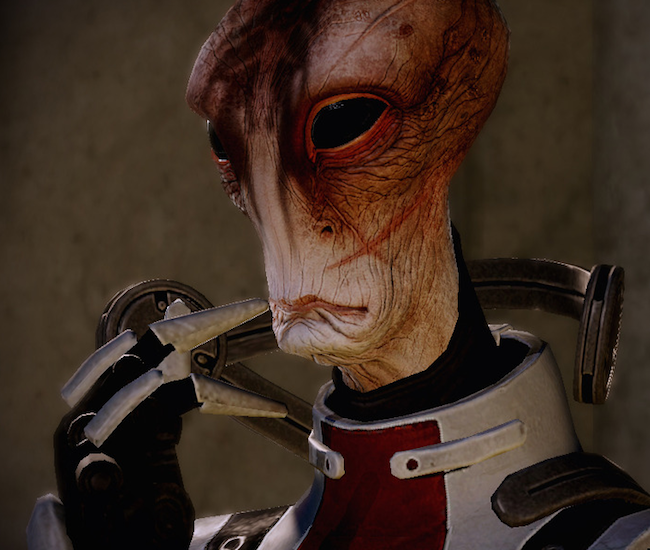
Ok, so “Mass Effect” is basically the “Star Trek” game we never got, so this is kind of a cheat.  Oddly enough, however, the video game world is not flush with capable, traditional doctors. Mordin Solus can not only heal a broken limb, or cauterize a wound, but his interstellar work experience has given him invaluable experience into dealing with every type of galactic calamity that may arise for a variety of species, while retaining the ability to keep a calm mind not motivated by personal conflict, and instead focused on what is best for all. Combined with his ability to project fire and ice from his bare hands at will, Solus is the only sawbones I want on my video game away team.

Second in Command: Gordon Freeman

He and Solus would have both been great candidates for the number two position on the crew, but Freeman has long proved himself as not just a capable man of science (even though the one experiment we saw him in went horribly, horribly wrong), but a leader of men as well. For reasons never quite explained, Gordon Freeman is a multi-talented, never wavering killing machine that has the ability to quickly decipher a variety of on the fly brain teasing situations. Frankly, he gets it done like no other video game character. While he doesn’t have the personality to lead a crew, he’s a better second in command than anyone can hope for.

Engineer : Cid Pollendina

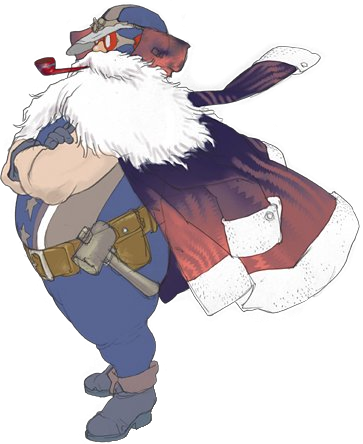
There’s been many variations of the Cid character, and while many of them were engineer types, and some people prefer the gruff Cid Highwind from “Final Fantasy VII,” to me the only engineer your team needs is “Final Fantasy IV’s” Cid Pellendina. He’s a little more fun loving than some of the other Cids, yet his work ethic is unwavering, and unlike Cid Highwind, you never have to worry about him falling into a bout of alcoholism, or for his nicotine withdrawals to interfere with his work. Also you can only really trust an engineer with a full beard.

Lieutenant: HK-47

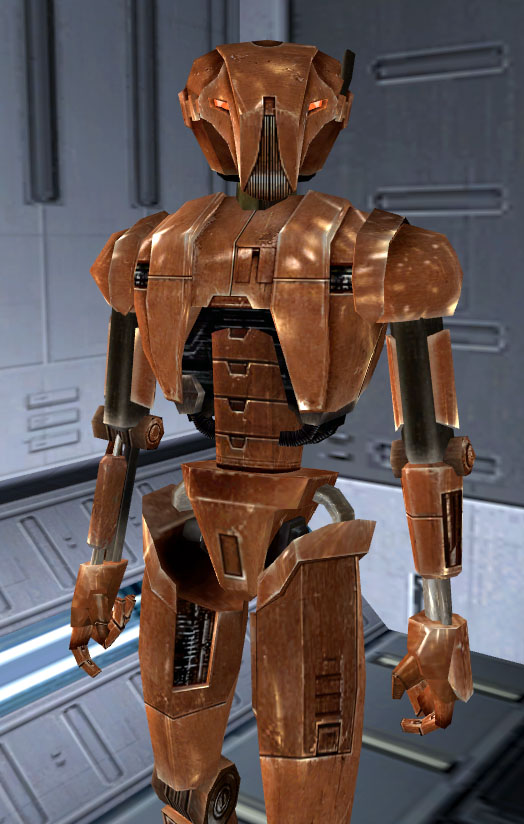
There’s a school of thought that says that a good lieutenant is always learning, fiercely loyal, and ready to step up and take charge at a moments notice. HK-47 has many of those qualities, but only if the mission is killing meatbags. Otherwise this assassin droid has a slight attitude and tendency to question orders, which can tend to discourage all but the most sociopathic of crew morale. However, sometimes you want an officer who is going to question your decisions, yet ultimately follow your final orders with machine like efficiency. HK-47 is that officer.

Communications: Cortana

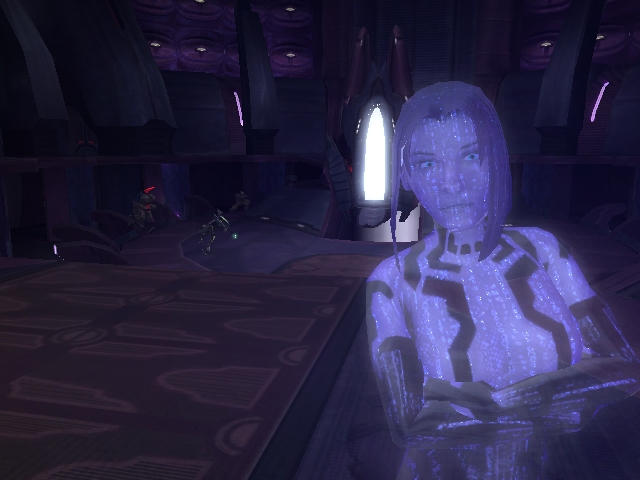
While lacking a physical form, though you wouldn’t believe it due to some creepy fan art out there, Cortana was made for communications duties. A constant source of information, whatever Cortana doesn’t know she can learn. Plus, much like the average smartphone, she can be taken anywhere and is ready to help whenever you need it. While she has lost her virtual mind in the past, making her something of a potential loose cannon, Cortana’s otherwise high level of artificial intelligence and intense loyalty make her the only real candidate for the job.

In any case, she’s much better choice than SHODAN.

A Serious Discussion About Comedy in Video Games

I was lucky enough to grow up a gamer during the NES era. I say lucky not just because, as a child, the NES was this mythical monolith of unlimited entertainment potential, but because I’ve been lucky to see video games evolve from the big bang moment that was Nintendo’s first console. In that time, what’s impressed me most evolution-wise isn’t the technological advancements the industry has enjoyed, but the artistic ones.

Writing quality would probably be the biggest improvement. Recently, I started playing “The Witcher 2,” and I’m finding it to be a watershed moment in video game storytelling. Sure, some of the dialog is groan-worthy, but the overall tale, and the brilliant way in which the game weaves it, is simply astounding. While it may be a beacon of writing quality in games, it’s far from the only port in the harbor. Games like “Braid,” “Bioshock,” and “Heavy Rain,” to name a few, have all gone far and beyond to prove that at their best, the stories of video games can bring out all of the same emotions as the stories in books, films and theater.

Except for humor.

Of course, I’ve laughed while playing games before, but it’s rarely been because of a specific joke made. Instead, by their general nature, video games are just light-hearted entertainment sources. Hell, the mascot of the entire industry might just be an underdeveloped Italian plumber with a hatred of reptiles, incredible jumping abilities, and a hard-on for elitist blondes. So for an artform that isn’t supposed to take itself too serious by its very nature, why is good, pure comedy so hard to come by?

Let me backtrack a little bit from that statement. I know that funny video games exist. I also know that comedy is perhaps the most subjective form of entertainment there is. What makes one person’s sides split causes another’s lips to droop. But still, that doesn’t mean that there aren’t works of comedy in other mediums that are generally considered to be undisputed comedy classics. Like “Caddyshack” or “Ghostbusters” or “This is Spinal Tap.” What is gaming’s equivalent? Well, type “funniest video games of all time into Google” and the consensus answer would seem to be “Conker’s Bad Fur Day.” I’ve covered Conker before, but just as a refresher, “Conker’s Bad Fur Day” is simply the raunchiest, most parody-filled, brute force comedy video game ever made.

And it’s not that funny. Well, I mean it is, but at best it’s a decent episode of “South Park,” without any of the clever context. “Conker’s Bad Fur Day” was a machine gun of jokes that figured if it fired enough rounds, one of them would hit just about everyone that played it. Even worse, it aimed that gun square at the stereotype that gamers are only 14 year old virgins, and made its name from it. And yet, to this day when people reference it, they use the words “Adult Humor.”

The King of Video Game Comedy?

Continue reading »

« Older posts Newer posts »

© 2026 Fearless Gamer

Theme by Anders NorenUp ↑