Tag: gaming (Page 10 of 11)

Five Things That I’m Excited About in “GTA: V” (and One That I’m Not)

Like the rest of you I’ve been following every morsel of information that has come from the many previews of that “GTA:V” demo, and like many of you, I’ve started to form my own impressions based on what has been shown so far.

While my overall impression is that I really need to start scheduling some serious free time come September, more specifically I’ve noticed at least five things from all of those previews that really excite me…and at least one that does not.

Five things I’m Excited For…

The Fun is Back

320(14)

“GTA:IV” had a lot of things going for it, but one aspect that irked me the longer I played is how much Rockstar veered from the wild, anything goes, comically deranged world of previous “Grand Theft Auto” games and instead aimed for something more grounded, and serious.

“GTA:V” looks to be a glorious return to those old ways, but also has clearly retained an aspect or two from its immediate predecessor. So while the trailers show things like deranged rednecks highjacking helicopters in flannel, cars chasing planes while pulling off insane maneuvers, and the glorious return of miniguns, it also takes a moment to reflect on the serious motivations that drive each of the three main characters, and to show that Rockstar is crafting a world every bit as jaw dropping as “GTA: IV’s” Liberty City.

In other words, it’s looks the way “GTA” should. A wildly fun game that’s not afraid to get serious.

Improved Combat

320(7)

One thing that I saw mentioned in several previews is that the combat is smoother than ever, with some comparing it to “Max Payne 3.”

“GTA’s” combat has been steadily improving over the years, but it still feels clunky for a game where there is a lot of it. It’s good to know that Rockstar looks to be making a concentrated effort to provide full coverage to the series Achilles heel, especially in a game that is already adding ambition to the system thanks to the three man system.

Which actually segues nicely to…

The Three Man Band

320(93)

The subject of who will be the next main character in “Grand Theft Auto” is always a hot one, as it usually sets the tone for the rest of the game.

When Rockstar first announced that there would be three main characters who can all be controlled at any time, it was hard not to think of it as gimmicky, and a bit of a reach. The more that’s revealed about it though, the easier it is to see that this is indeed the most exciting change to come to the series, possibly ever.

From unique but intersecting plot lines, to the ability for characters to “do their own thing” while not being under control, to the amazing way that combat and heist scenarios make use of every character individually, this sounds like the first “Grand Theft Auto” in a while that is going to have people re-thinking how they play the series.

Money Matters

320(9)

In a misstep so big I still question if it was an error by the designers, money in “GTA:IV” was more or less useless. It didn’t take long to acquire enough dough to keep you rolling in suits and guns for the rest of your days, and even though money was always brought up as a plot point (more on that later) you always ended up with too much of it, and nothing to do about it.

Rockstar must have been aware of this, as they have confirmed that “GTA:V” will require you to have a constant cash flow in order to purchase all of the clothing, vehicles, and (most importantly) properties the title has to offer.

That means that no longer will you be able to buy a $3000 suit you already own just because the store is closer than your closet, and I for one am excited to start earning with purpose again.

A Driven Story

320(2)

If I sound like I’m hating on “GTA:IV” here, it’s because I am. While by no means a bad game, it is by far the most overrated game of this console generation, and a big part of that is due to a meandering story that dragged on and on without any real focus, or compelling reasons to keep pushing ahead besides the satisfaction of beating it.

“GTA: V” seems to be resolving this by focusing the majority of its story on a series of high profile heists. The mission highlight of “GTA:IV” is, of course, the brilliant bank job in three leaf clover, and it’s clear that Rockstar thought so too, as this time many missions will revolve around prepping for, or executing, heists as part of your three man crew.

It’s not a guarantee for a greater plot, but it sounds a lot more promising than working for a series of cardboard cutout thugs with vague notions of revenge and some superfluous cash being your only driving force.

…And the One I’m Not

You Can’t Shoot the Paparazzi

320(8)

What?

See during the IGN rundown of the demo it was brought up that there is a side mission where you escort a spoiled starlet and try to escape the paparazzi. When the questions was brought up if you could just kill them instead of escaping them, the answer was a surprising “no” as that causes you to fail.

I understand that Rockstar is aiming for a much more cinematic experience than before, but I’m really bummed out that in something so minor as a simple side mission, the game will limit your options for the benefits of that goal.

Games like “The Walking Dead” show that choice can be a huge benefit to storytelling, while titles like “Saint’s Row The Third” exemplify how creating a truly open world lends so much more to sandbox games. I just hope that in a game that promises to be the series biggest and boldest yet, there aren’t a series of similar limits that keep it from reaching that lofty height.

One Game Developer is Not Letting Video Game Piracy Ruin Their Fun


Chris Rock once said on monogamy that a man is “basically as faithful as his options.” In other words, if they have the ability to cheat, they are much more likely.

The same can easily be said when it comes to videogames and piracy. Everyone knows how much of a problem piracy is, yet many still succumb to the allure. After all, it’s easy, it’s free, and you don’t even have to see the victims if you don’t look hard.

However, the victims are very real, and the numbers to support it are staggering. Take for instance the recently released indie game “Game Dev Tycoon,” where you are tasked with running a video game development studio. It’s been announced by the game’s developer that figures seem to show that of the roughly 3300 copies of the game being played so far, a whopping 93.6% are pirated copies. Naturally for a small studio like Greenheart Games, or anyone really, those are crippling.

While cases like this are all too common, this one does have a silver, and very humorous, lining.

See, it turns out that a large part of the reason that the developers have such accurate figures for the pirated copies, is because they released their own pirated version of the game. Besides using it to fish for statistics, they also programmed these games with a very important feature, where a warning message pops up that the fake games your fictional in-game studio develops are being heavily pirated.

The problem becomes so great, that sooner or later you eventually will lose your studio as you usually can’t profit enough to get ahead, making those copies of “Game Dev Tycoon” essentially unwinnable.

While that’s humorous enough as is, the best part of this story has to be the befuddled reactions from the users of these pirated copies, as they just can’t understand why this is happening in their game, and are pleading with other players for a way to resolve the issue. One even remarks that the whole thing is “not fair,” while another asks is DRM can fix the problem.

While the irony there is seemingly only lost on the people affected, the real irony is that the people who pirated the game about running a video game development studio seem to have gotten the most realistic version of that process. Gaming needs an indie scene to challenge the perceptions of the industry and test the waters of what works and what is accepted at large. Piracy kills that creative market, and unfortunately a viable solution on a massive scale has not been presented yet, and quite possibly never will.

Still though, it’s nice to know that pending financial and creative doom hasn’t deterred the better spirits of at least one developer, and it’s hard to not applaud them in their efforts to make a small, but very clear, stand against the matter the best way they know how.

Much Like the Kinect, Microsoft’s Latest Decision to Take the Control of Games out of the Gamer’s Hands, Will be a Failure


I may never get a chance to do so elsewhere, so let me pay tribute to one of my favorite critics, the late, great Roger Ebert, by paraphrasing his famous review of the film “North” to convey my feelings on the news that the next Xbox will likely require you to always be online.

I hate that idea. Hate it, hate it, hate it, hate it, hate it. Hate it. I hate every simpering stupid vacant audience-insulting implication of it. It hate the sensibility that thinks anyone will like it. I hate the implied insult to the audience by its belief that anyone would be entertained by it.

While still not the official Microsoft statement, the recent, and soon to be infamous, tweets of Microsoft creative director Adam Orth on the subject seem to imply that if Microsoft isn’t already committed to the idea of making a console that requires an internet connection, they’ve certainly considered it.

Specifically he summed up the notion of a console that requires an internet connection with three simple words.

“Deal with it.”

Used as a rebuttal to every befuddled complaint thrown his way, Adam Orth would like it very much if we never dare question the motivations or intentions of Microsoft again. Because of these outlandish and insulting comments, Microsoft is now the ones who have to “deal with it,” as they scramble to make sure everyone knows that the views of Adam Orth “Do not reflect the customer centric views we take to our products.”

If you haven’t done so already, please take a moment to laugh at that statement. You can either laugh at the implication that the creative director of Microsoft’s views somehow do not reflect the company he works for, or have a chuckle at the fact that the problem isn’t his viewpoints necessarily, but rather that he couldn’t say them in a more PR friendly manner.

Whatever you do though, don’t take this situation seriously. I do not mean to expect these rumors to turn out to be false (they most likely aren’t), but rather do not join the legions who will suddenly give credence to the notion of an online required console as a possible evolution of the medium, or attempt to play the devil’s advocate on the subject by attempting to analyze the notion as an inevitability.

For supporting this idea, Microsoft  is simply wrong. They were wrong when they released consoles that died more frequently than a light bulb, and they are wrong again in creating a new system that once again suggests that purchasing a console and owning a game does not guarantee your ability to use either.

There is no logical argument that exists to support a DRM system in the current state the technology exists in, for anyone not on the corporate take. While there are an abundance of logical arguments against the system, none should be used to entertain this particular notion. Instead, if you are opposed to this idea, please just laugh uncontrollably at it anytime a Microsoft representative brings up the idea publically, in order to pay the same respect to them, that they do to you by supporting DRM.

If the next generation Xbox is online only, it should also come with a statement that all owners must sign, have notarized, and officially submit to a court of law. That statement will read:

“We hereby wave our right to ever complain through any available medium regarding any technical issues that may arise preventing us from using our systems. We have weighed our options to choose rationality and common sense against blind allegiance, and have chosen to deal with it.”

The 31 Horror Games of October: Part 3

Part 1

Part 2

As Halloween draws near, here are the final 10 greatest horror games of all time, any of which would be more than worthy for a Halloween night marathon.

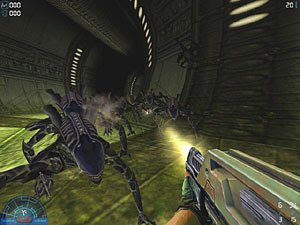
10. Alien vs Predator 2 – A couple funny things about this game being on this list. One, its actually more of a sci-fi shooter than a full on horror game. Two, there are three main stories to play through and two of them (that have you playing as the alien and the predator) are entertaining, but far from scary. What gets it on the list is the 5-8 hour colonial marine campaign. If the best aspect of horror games is how they make you feel like you’re not ready for what’s next, then this may be the best example of it.

Around every corner waits a new threat, and the tension of awaiting it is only outmatched by the fright itself. It may be a sci-fi game but it’s also one of the best examples of the “haunted house” effect I can think of. You would think that the heavy arsenal at your disposal would help, but it only leads you into a false sense of security. The “Alien vs Predator” movies may have been abominations, but if you never played this game, I can’t begin to adequately describe the terror you are denying yourself.

9. Call of Cthulu: Dark Corners of the Earth – An almost impossibly underrated title, where as most horror games take elements of the works of H.P. Lovecraft for their scares, this is a direct adaptation of several of those titles. What I love about the game is how much it feels like a love letter to the genre, as so many elements present in the game are horror conventions that are effectively implemented so that they sure to give any fright fan an impossible to shake ear to ear grin. Well, until it’s replaced with a look of cold fear that is. As much as “Call of Cthulu” is a fun experience, it is an even greater trip through pure terror. The monsters design is superb, the ammo is appropriately sparse, the sound is a highlight reel of bumps in the night, and the game features some of the best set piece moments you’ll see in the genre.

Particular mention here must go to the escape scene in the town of Innsmouth, where your early investigations lead you to conclude that everyone in the town is incredibly indifferent, and even hostile. That instinct would turn out to be dead on as the entire populace starts chasing you with the intention to kill. It’s a flawless escape sequence that puts you into the game like few other titles can even hope to do, and is a perfect example of the brilliance of this title.

8. Dead Space – Picking up “Dead Space” originally for a quick play through, I didn’t understand the hype. After all, at the time it was being heralded as the savior of the survival horror genre and one of the most terrifying games ever made to boot. My mistake was only playing the game for a short burst though.

“Dead Space” is a game that begs you, even dares you, to immerse yourself in it. Turn off the lights, shut down the phone, crank up the volume, and see how far you can make it before the sheer terror overwhelms you. The brilliance of “Dead Space” is in the collection of all the little things it does well, like removing a lot of the traditional HUD elements on the screen and subtly putting them on your characters back, or how almost all of your weapons are mining tools re-purposed for your current slaughter needs. There’s also the bolder elements like the horrific creature design, and the emptiness of the space station setting making you feel like you are truly fighting your way out of hell and into the unknown. I was gravely mistaken for thinking “Dead Space” was anything less than one of the greatest horror games of all time, and I now recognize it as perhaps the prime example of effective atmosphere in gaming.

7. Left 4 Dead 2 – The greatest zombie game ever made? Well…not quite but it is certainly the most entertaining. Valve struck horror gold when they devised the idea of allowing 4 players to fight their way through the zombie apocalypse in the original “Left 4 Dead.” With the sequel, they perfected the experience by incorporating more enemies, more characters, better levels, and more modes.

The entire game works because of its intense level design which is open enough to make you feel like you’re not boxed in, but still linear enough to make the choke point moments work. Even better is the community aspect, as “Left 4 Dead” perfectly allows you to live out those conversations you have with your friends about what you all would do in a zombie apocalypse. That’s not to say the game is entirely about fun, as the scares are plentiful and often come in the form of the sheer overwhelming numbers you face, and the special zombies that complicate your survival intentions with their unique abilities (especially the Witches, which are essentially the nuclear weapons of the zombie horde). “Left 4 Dead 2” is a simple idea executed to absolute perfection.

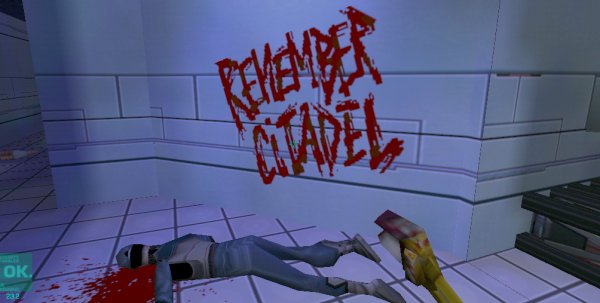
6. System Shock 2 – Remember earlier when I mentioned that “Dead Space” is perhaps the prime example of atmosphere in gaming? Well, that’s because there are a couple of other contenders on this list, with “System Shock 2” being chief among them. The theme of the game is isolation, as you are sent to investigate the sudden stoppage of the world’s most advanced ship. One it becomes clear that something has gone horribly, horribly wrong on board, your only companion is a surviving analyst who guides you to her location, and your only goal is to survive and hope that by reaching her you can regain a sense of perspective about what is going on around you. In your path is a host of mechanical and organic enemies as well as a very real sense of hopelessness that threatens your progress more than any in-game element.

“System Shock” is the spiritual pre-cursor to “Bioshock” and many of its elements were highly influential on the “Deus Ex” series. While that gives you an idea of how revolutionary it was at the time, I’m happy to say I can do no real justice to the game’s atmosphere. You are truly alone in this world. While it’s a world filled with incredible amounts of backstory and political intrigue if you go looking for it, that doesn’t make it feel any less unwelcoming. Capped off by one of the greatest plot twists in video game history, “System Shock 2” is one of the few great entrants of the horror genre in the games are art debate.

Continue reading »

Cavanagh vs Killingsworth: This Super Hexagon Ain’t Big Enough

Of all of the concepts in video game history, only one seems to have the unique attribute of being both completely irrelevant, and strangely everlasting.

It’s the concept of high scores.

Long ago (I would say even into the Super Nintendo era) the need and use for high scores in video games as a dominate means of measuring achievement feel to the wayside. In its place came the greater ideas of narrative, exploration, and eventually direct competition, creativity and, of course, unique individual game achievements. In other words, pretty much everything but a rolling tally of numbers is used to judge gamers, and games, by skill and merit.

And yet, even as gaming spreads more and more into the public conscious, the idea of a high score and video games still goes hand and hand. To this day, you still hear movies and other mediums throw out the line “I beat my high score!” or something similar when the story calls for a gaming reference. In a way it’s no surprise. The idea of one set of numbers being greater than another is used in so many other fields to declare a winner that its natural for that same feature to be the defining characteristic of victory for gaming as well in the eyes of many.

Of course, with the explosion of mobile gaming, the idea of a high score is becoming slightly less barbaric than it once was. Those simple app games are re-exploring the concept and, thanks to the global communication devices they often run off of, are also bringing back the idea of the classic arcade concept of communal high score competition. Just like an arcade, there are of course those gamers that shine above all others, and whose names remain such fixtures on the tops of leaderboards that you would think they were programmed there. Also, much like an arcade, every now and then a small group of those superior scorers will engage in a back and forth over the top spots that creates one of the competitive concepts that you see in just about every other field with regularity except for gaming. Genuine, individual player vs individual player rivalry.

Right now on the leaderboards of “Super Hexagon,” this rare moment is occurring. Even better, it’s not two civilians that are engaging, but two heavyweight players. In one corner is Terry Cavanagh. Terry has the unique “Super Hexagon” advantage of not only having programmed “Super Hexagon”, but creating the damn thing in the first place. The game’s challenge of moving a small triangle through a pulsating and vibrant tunnel of constant death is his doing. Actually, allow me a quick sidebar here before we move any further. If you’ve never played it, “Super Hexagon” can be sadistic. Think, “Dark Souls” without the thrill of accomplishment, because there rarely is accomplishment to be found within its impossible confines.

Yet this common idea doesn’t hold for Cavanagh who constantly finds himself atop the leaderboard. He isn’t doing it through any programming advantages either. The man is just that good and, even more important, is obsessed with remaining the best player in the world. He constantly checks in to see if anyone is eyeing the throne, and smites all those who would seek to replace him.

It’s a madness that has worked so far and, were it not for Jason Killingsworth, Mr. Cavanagh may be a man without rival.

Have you never heard of Jason Killingsworth? Well along with being an editor for Edge magazine, he’s also something of a gaming daredevil. His accomplishments include beating every challenge in “Super Meat Boy” (a game designed, more or less, not to be beaten), garnering every achievement in “Spelunky” (which you have to look up, to truly appreciate), and he’s also a strong advocate of unpopular ideas like the 100 hour video game. In an interview with Wired, whose interview broke this story, he puts his motivation best:

“I have near-crippling levels of perfectionism,” Killingsworth says, and a penchant for exquisite challenges. “Most games these days feel like cow-tipping — the only requirement to succeed is to possess at least one working arm,” he says. “I want to spend my gaming hours breaking crazy-eyed, bucking stallions.”

The blindingly fast “Super Hexagon” is his latest stallion, and therefore,  so is the high score of Cavanagh. Their competition hasn’t been so much a sweet science, as it is a stick and move affair. Killingsworth takes a jab, Cavanagh posts a new score moving farther out of reach. It’s the same, again and again. Only recently, has a true counter-strike has been landed as Killingsworth has beaten Cavanagh in the games third highest difficulty by 12 seconds. It’s not total victory, but for a creator who has a “Frankenstein” like obsession with his work, it’s enough to make him sweat and feverishly check the leaderboards each day to make sure Killingsworth doesn’t claim even part of the kingdom for long.

Yet, like all great champions, he is still gracious in defeat as he is quick to praise Killingsworth for accomplishing what few, if any more, ever will. He does this for the same reason he is so adamant about maintaining his spot on the leaderboard. Because he just wants to promote the game he is so proud of.

That, is the biggest reason this one of my favorite gaming stories of the year. Someday someone is going to have to invent a better phrase for it, but until then this is simply old school gaming at its purest. It brings back such glorious concepts of arcade spirit and high score competitions, that aren’t marred by things like cheap tactics, glitch exploitation, or the dreaded pre-pubescent bewildering smack talk that plagues so many other competitive games either. No, somehow in an industry that is becoming more and more obsessed with corporate ideas, lies a high profile back and forth between a game creator who just wants everyone to love his game as much as he does, and a hardcore gamer who welcomes challenges that take no prisoners.

In other competitive fields they refer to events such as this as being for “the love of the game”, or representing “the integrity of the sport”. Video games don’t really have a similar phrase, but the beauty of it is they don’t need one. Because in a simpler time, we just called this gaming. In a more complex age, that’s thankfully all this still is.

« Older posts Newer posts »

© 2026 Fearless Gamer

Theme by Anders NorenUp ↑