Author: Matt Byrd (Page 31 of 34)

Surprise Video Game Successes

We’re really starting to hit that horrible lull in the year when it comes to video game releases. I don’t know what the complete logic behind it is, but for some reason, game development companies do not see fit to release big titles during the summer months, and instead prefer to back up the holiday season with every title in their arsenals, Triple-A release or otherwise. It’s not fair for gamers who would like to stretch their funds and time instead of trying to invest everything they have into a two-month period at the end of the year.

It’s this time of year that you have to hope for a good surprise to come along and really blow you away. While everyone enjoys riding the hype wave of a major release, and enjoying the fruits of your patience on a game’s release date, there is no feeling that is comparable to that experience when you go into a title with zero expectations only for it to send chills down your spine with just how good it is.

To prove this theory, and maybe generate some positive vibes so a sleeper hit will come our way again, here’s a small sampling of some of the greatest surprise hits of all time.

“Minecraft”

It’s fitting that a game all about building also represents the typical building blocks of a surprise hit. It had no hype, no budget, a no-name developer, and no real precedent as far as its concept.

I don’t remember when “Minecraft” took the world by storm, but it wasn’t quite after its 2009 beta release. Instead, it was sometime after that when people’s creations started appearing online, and when every game site in the world ran a 200 word feature piece about some novelty game called “Minecraft” that was gaining steam. Slowly, as the unlimited potential the game’s engine possessed became more and more clear, gamers everywhere divided themselves into two groups. Those who “got” “Minecraft,” and those who didn’t.

Of course, going off sales figures, those who got it would seem to make up the majority. By 2011, “Minecraft” surpassed 10 million registered users on the PC, and its release on the Xbox 360 broke the XBLA sales record. Keep in mind that through all of that, the game has still never had any real commercial advertising. While many would say that should be impossible in this day and age, “Minecraft” appropriately continues to thrive in a world it’s built for itself.

“Katamari Damacy”

It’s usually fairly easy to tell when a game developed in Japan is going to make it to American store shelves. If it’s the new “Final Fantas,y” it’s probably a pretty good bet you’ll see it stateside. If it’s a mech-noir dating simulator, chances are slimmer.

So it’s still something of a mystery, then, how a game that features a deformed space prince rolling up a perpetually growing ball of objects to replace the various cosmos his father, the King of the Cosmos, accidentally destroyed would end up a smash hit. There’s little doubt that the concept of “Katamari Damacy” is what got gamers to give it a try, but from there it was the game’s simple controls and creative and addicting gameplay that really started moving titles off the shelves in earnest.

It’s odd that the very concept of “Katamari Damacy” both alienated it to start, and made it irresistible thereafter. It just goes to prove that the occasional chance against all odds, can result in a success story worth more than all the failures that led there.

Continue reading »

Wii U, Xbox 720, PS4…Ouya?

Originally, I wasn’t sure whether or not to report on the Ouya, mostly because I feel like I met my quota on farfetched console rumors with that Xbox 720 report leak. However, between the underwhelming Wii U unveiling at E3, and Microsoft and Sony remaining mum on their future plans, 720 leaks aside, it’s getting harder and harder to get properly hyped up for the next generation of consoles based on mere official information. So here I am, reporting on another console that may or may not exist.

Cynicism aside, the truth is that there are a lot of reasons to be excited about the Ouya. Because Ouya isn’t just a vaguely dirty-sounding word, but is instead a rumored new entrant into the console wars that has the backing of veterans like Ed Fries (Xbox) and CEO Julie Uhram (IGN).

Now, obviously, anybody trying to make a successful new console has to have an ace up their sleeve to separate themselves from the industry giants. The Ouya’s trump card, as first reported by The Verge, is its Android-powered core, which will supposedly help the console double as a development kit. Essentially, the Ouya is “hacker friendly” and allows for gamers that buy it to create their own titles. Even more appealing is the consoles alleged price tag, which is said to be set at $99, and will feature completely free games.

While there is apparently more information about the Ouya set to break in the coming days, what we have now is tantalizing enough. The idea of a major release system encouraging a lassez faire attitude towards its consumers concerning security policies and publishing rights is an interesting one, and brings consoles closer toward their seemingly inevitable assimilation with some of the finer points of PC gaming. In fact, there is a lot about the Ouya that reflects the recent evolutionary trends in gaming. It combines a little bit of mobile app gaming, the explosion of the indie development market, and is supposedly set to offer the whole package to you for a foundation-shattering price point.

It’s a console based around the concepts of freedom and independence, making the 4th of July the perfect day to consider its potential impact. Because honestly, whether or not the Ouya bucks the trend of previous cinderella entrants into the console market and actually makes it is, at this time, largely irrelevant. As the “Madden” franchise has shown, when there is a lack of real competition in a market, it’s hard for your product to not become stale. And if even half of the information about the Ouya turns out be accurate, it is at least an exciting idea that may hopefully force the major players to consider the benefits of its more appealing ideas.

Dreams Come True for Sega Fans

I don’t want to restart a video game war that went cold over a decade ago, but it’s hard to deny that the PlayStation was the better buy than the Sega Saturn.

I know, I know, here comes the usual Saturn fan argument. “Panzer Dragoon,” “Guardian Heroes,” “Nights Into Dreams.” That last one, in particular, has been a longtime cult favorite, and fans have been clamoring for years for Sega to re-visit “Nights.” Sure, there was that Japanese exclusive PS2 remake, and a mediocre semi-sequel on the Wii,  but none of it has fully satisfied fans’ bloodlust following the original title.

Well, not long after releasing a teaser image related to the game, Sega has gone all-in and announced a full-on HD remake of the original “Nights” to be released on Steam, Xbox Live Arcade, and Playstation Network. Besides including little pieces of the blown minds of hardcore fans everywhere, the remake will boast standard upgrades like HD graphics, widescreen compatibility, achievements, and a “Saturn Mode” that lets you play the game in its original format.

If you never played “Nights,” the reasons you should be excited for this remake are a lot of the same reasons I outlined previously for why “Earthbound” is my favorite game of all time. It’s a title brimming with style, that’s all about exploring the world of dreams via flight. Appropriately then, the best way to describe the majority of the games features is dream-like. The flying controls that make up the majority of the game handle loose and free, while a brilliant soundtrack fills the landscapes you explore, giving you a sense of freedom that has nothing to do with a concept like sandbox gaming. Instead, “Nights” surrealism frees your mind and makes you believe that even though the game has well established parameters, that somehow anything is still possible.

Yet there’s a reason this game is considered a “cult classic” and not a runaway contender for best game of all time. It’s not entirely due to the fact “Nights” came out in the dying days of a mostly underwhelming system, either. Truthfully, once you get past the game’s thrill of flying, it’s hard to not see that the majority of “Nights” is standard platforming item-fetching that is handled in a style that’s not quite on the rails, but is still more linear than it initially appears to be. Even the flying aspect has lost some of its appeal over time as it was largely based around the appeal of exciting new “analog stick technology” that has of course become anything but novel since.

I know that remakes and re-releases are big money in the video game market right now (and some, like the “Metal Gear Solid” and “Splinter Cell” collections are wholly justified), but Sega is putting their fans in an awkward position with a release like this. On one hand, not supporting this game by buying it may make Sega believe that there is not the interest in their classic library that there definitely is and should be when it comes to generally good gaming ideas. However, if fans jump on this title with the same rabid ferocity that they have shown in clamoring for its release all these years, then they will be effectively sending the message that a bare bones HD re-release is good enough for them.

There’s a group of people out there that will be happy enough buying a title like “Nights” to enjoy for an afternoon of nostalgia and be perfectly happy with it. Maybe, with the right expectations, there is nothing wrong with that. I just hope that game developers are also taking time to consider the little aspects of titles like “Nights” that have made them remain so beloved over the years, and are looking to expand those ideas into future original properties. Maybe that’s just wishful thinking, but if it’s not the case, then in the end, releases like these really are nothing more than cash grabs.

Quinn Pitcock’s Struggle to Tackle His Video Game Addiction

I’ve never really thought I had a problem with video games. Well, I still can’t beat Mike Tyson in “Punch-Out,” and the only reason I’ve ever gotten past that driving level in “Mafia” is by cheating, but what I mean is that I’ve never felt like I’ve ever had trouble balancing games with the rest of my life. While gaming is one of my great passions, I’ve been fortunate enough to find other passions in life that made it impossible to think about spending all of my waking time with just one of them.

However, I do realize that video game addiction is a problem that exists. For former NFL defensive lineman Quinn Pitcock, it’s a very real problem that may keep him out of the league.

Pitcock refers to himself as an introvert who can spend 18 hours a day playing “Call of Duty.” He says that, “The only way I could get my endorphins was by playing video games.” Realizing the depths of his addiction, he has gone to such dramatic lengths as physically breaking his games to try to make up for not being able to stop playing via his own will. Yet for all of his efforts, he has so far been unable to break his crippling addiction.

More than just register as a gross personal flaw, though, this is a problem that may permanently affect Pitcock’s career. That’s because he retired from football in 2008, after a somewhat impressive rookie season with the Indianapolis Colts, and has made two different unsuccessful attempts at a comeback since. Pitcock says he immediately regretted his decision to retire originally, but instead of refocusing his efforts to get back into the game, he instead sank deeper into his drug of choice. While he does play for the Orlando Predators of the Arena Football League (and the Indianapolis Colts helped him find a psychologist to help with his addiction), he now has recently revealed that he has a legitimate worry that NFL teams will not trust him to be successful in his recovery efforts.

“They’re more comfortable with a drug addiction,” Pitcock says. “It’s unfortunate. It definitely hinders my chances.”

While that may sound like a ludicrous statement to some, the fact is that video game addiction is a mental addiction, which is considered much more problematic to break than a physical one. Let’s not forget the plight of one of the most talented football players of all time, Ricky Williams, whose addiction to marijuana was so severe that he once stated that his desire to smoke marijuana was greater than his desire to play football. Marijuana, like video games, is not a drug that is considered to be supremely addictive or inherently dangerous. Yet to the right mindset, both can be just as dangerous as any other substance.

I almost wrote this piece as a humorous article. The NFL player who’d rather play “Madden”…something like that. But the truth is that it’s hard not to feel sympathetic to Quinn Pitcock. Like I said, I’ve been lucky enough to find other passions that have kept my life from revolving around video games entirely, but that doesn’t mean there weren’t brief flirtations with having it become a problem.

To make it to the NFL, it takes an almost inhuman mix of skill and dedication. It’s obvious that on some level Quinn Pitcock still has both. However, as Voltaire said, “It is difficult to free fools from the chains they revere.” Hopefully, Pitcock will be able to able to find the right balance in his life for all of his passions, and live without those chains.

Team Fortress 2 and Other Games That Would Make Great TV Series

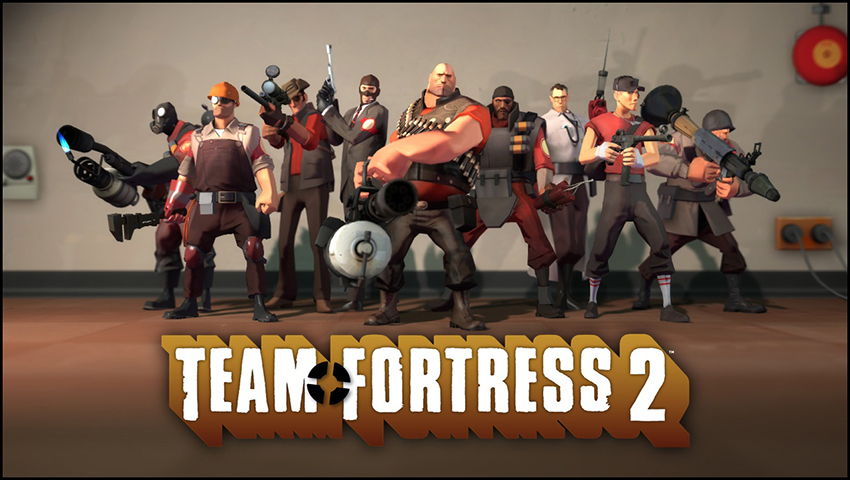
If you head over to Adult Swim’s website right now, you’ll find an interesting teaser. Apparently, next week Valve and Adult Swim are going to be revealing a collaboration that they describe as “their video game peanut butter… our network chocolate” and “something that you’ll probably enjoy.” The picture accompanying the announcement makes it pretty clear that this is something “Team Fortress 2“-related, and speculation everywhere has it at everything from the long-awaited “Meet the Pyro” episode of the “Meet the Team” series, to a full-on new TV series based on the insanely popular online shooter.

Considering that “Team Fortress 2” is one of the most purely entertaining games of all time, with a comic style and personality that is unmatched in its medium, and that those “Meet the Team” videos are some of the funniest things ever produced in relation to a video game, whatever comes of this announcement is sure be a bonafide success.

Personally, I’m hoping for a “Red vs Blue” style online miniseries.

It is odd, though, that video games and television shows are two mediums that don’t have much of a celebrated history, or anticipated future of collaboration. Video games made into movies have been a popular subject of discussion for years, but for some reason very few people ever consider the potential for games as TV shows. While “Team Fortress 2” might be the strongest argument for the games to series transition in the history of video games, the truth is that I think there are at least five other titles that would do very well in an episodic format.

“Fallout”

How It Would Work: Three letters. H-B-O. The world of the “Fallout” series is one of the most brutal, bleak and terrifying of all time. Around every corner waits a new horror and atrocity, and just about every person left has become a hardened bastard because it’s the only thing that’s allowed them to survive.

It’s the perfect world for HBO’s no limit programming.

More than the violence, though, this show would need HBO’s creative freedom to really showcase the  “Fallout” series’ biggest success, and that’s the world it takes place in. The 50s style atmosphere, mixed with the total apocalypse, is the thing that made the series stand out above all others, and it leads to some of the greatest dark humor in any medium. From the always gleeful “Fallout Boy” mascot to the incredibly inappropriate yet oddly fitting classic soundtrack, there is so much in this series that you wouldn’t have to change a bit of to make it shine as something truly unique and incredible.

What’s better is that you wouldn’t be stuck with the parameters of the series story either. There are so many tales waiting to be told that you could just borrow ideas from the established parts of the series and have more than enough foundation for even a mediocre script writer to build something truly compelling with.

In fact, with the possible exception of “Team Fortress 2,” “Fallout” is the series perhaps most primed for television. Just please… no Deathclaws. They scared me enough in the game already when I accidentally found Old Oney too early, and I certainly don’t need any more of them.

Continue reading »

« Older posts Newer posts »

© 2026 Fearless Gamer

Theme by Anders NorenUp ↑