Tag: Video Games (Page 22 of 24)

EA Shuts Down PopCap’s Dublin Studio

I love PopCap Games, and I’m not ashamed to admit it.

While some deeply entrenched veteran gamers consider them a mainstream harbinger of doom, the fact is they have produced some of the most purely addictive games of this, or any, generation with titles like the hall of fame “Bejeweled,”Plants vs Zombies,” “Bookworm,” and the glorious “Peggle.” They toe a fine line between “mainstream” (in the dirty word sense) and merely accessible, and their constant goal of gameplay over graphics and fun over flash is inspiring.

Which is why it’s sad to see that they have become the victim of some massive layoffs, as EA (who bought them out for around $750 million last year) announced the shuttering of the team’s Dublin studio. While the move has been long rumored, that’s certainly no condolence for the 96 employees who were laid off due to this move as they join the initial fired employees who lost their jobs when EA took over last year.

EA has been clear on their reason for this move, saying that they are trying to trim down aspects of PopCap that are similar to services they already offer, and the Dublin studio’s efforts apparently did not fit the need of EA in accordance to their plans moving forward. Both EA and PopCap have announced that many of the employees from the shuttered branch will have employment opportunities available at other PopCap locations and at EA operations, which include call center positions.

There’s far too many EA is the evil empire articles out there to still have any effect, and I don’t wish to contribute to them here. I will say this though. You may recall that PopCap gained a reputation early on for offering their games for free trial before purchase to help promote them. Even when they featured their games on Steam, they insisted the free demo still remain an option, as they were that confident in their products, and couldn’t wait to share them with the masses.

It’s just a shame then that such a company that held that philosophy had to fall to something like budget cuts and corporate strategy. Good luck to all of the employees of the former Dublin studio, and to PopCap itself who I hope can recover from this round of bad news and continue to produce at a high level.

Cavanagh vs Killingsworth: This Super Hexagon Ain’t Big Enough

Of all of the concepts in video game history, only one seems to have the unique attribute of being both completely irrelevant, and strangely everlasting.

It’s the concept of high scores.

Long ago (I would say even into the Super Nintendo era) the need and use for high scores in video games as a dominate means of measuring achievement feel to the wayside. In its place came the greater ideas of narrative, exploration, and eventually direct competition, creativity and, of course, unique individual game achievements. In other words, pretty much everything but a rolling tally of numbers is used to judge gamers, and games, by skill and merit.

And yet, even as gaming spreads more and more into the public conscious, the idea of a high score and video games still goes hand and hand. To this day, you still hear movies and other mediums throw out the line “I beat my high score!” or something similar when the story calls for a gaming reference. In a way it’s no surprise. The idea of one set of numbers being greater than another is used in so many other fields to declare a winner that its natural for that same feature to be the defining characteristic of victory for gaming as well in the eyes of many.

Of course, with the explosion of mobile gaming, the idea of a high score is becoming slightly less barbaric than it once was. Those simple app games are re-exploring the concept and, thanks to the global communication devices they often run off of, are also bringing back the idea of the classic arcade concept of communal high score competition. Just like an arcade, there are of course those gamers that shine above all others, and whose names remain such fixtures on the tops of leaderboards that you would think they were programmed there. Also, much like an arcade, every now and then a small group of those superior scorers will engage in a back and forth over the top spots that creates one of the competitive concepts that you see in just about every other field with regularity except for gaming. Genuine, individual player vs individual player rivalry.

Right now on the leaderboards of “Super Hexagon,” this rare moment is occurring. Even better, it’s not two civilians that are engaging, but two heavyweight players. In one corner is Terry Cavanagh. Terry has the unique “Super Hexagon” advantage of not only having programmed “Super Hexagon”, but creating the damn thing in the first place. The game’s challenge of moving a small triangle through a pulsating and vibrant tunnel of constant death is his doing. Actually, allow me a quick sidebar here before we move any further. If you’ve never played it, “Super Hexagon” can be sadistic. Think, “Dark Souls” without the thrill of accomplishment, because there rarely is accomplishment to be found within its impossible confines.

Yet this common idea doesn’t hold for Cavanagh who constantly finds himself atop the leaderboard. He isn’t doing it through any programming advantages either. The man is just that good and, even more important, is obsessed with remaining the best player in the world. He constantly checks in to see if anyone is eyeing the throne, and smites all those who would seek to replace him.

It’s a madness that has worked so far and, were it not for Jason Killingsworth, Mr. Cavanagh may be a man without rival.

Have you never heard of Jason Killingsworth? Well along with being an editor for Edge magazine, he’s also something of a gaming daredevil. His accomplishments include beating every challenge in “Super Meat Boy” (a game designed, more or less, not to be beaten), garnering every achievement in “Spelunky” (which you have to look up, to truly appreciate), and he’s also a strong advocate of unpopular ideas like the 100 hour video game. In an interview with Wired, whose interview broke this story, he puts his motivation best:

“I have near-crippling levels of perfectionism,” Killingsworth says, and a penchant for exquisite challenges. “Most games these days feel like cow-tipping — the only requirement to succeed is to possess at least one working arm,” he says. “I want to spend my gaming hours breaking crazy-eyed, bucking stallions.”

The blindingly fast “Super Hexagon” is his latest stallion, and therefore,  so is the high score of Cavanagh. Their competition hasn’t been so much a sweet science, as it is a stick and move affair. Killingsworth takes a jab, Cavanagh posts a new score moving farther out of reach. It’s the same, again and again. Only recently, has a true counter-strike has been landed as Killingsworth has beaten Cavanagh in the games third highest difficulty by 12 seconds. It’s not total victory, but for a creator who has a “Frankenstein” like obsession with his work, it’s enough to make him sweat and feverishly check the leaderboards each day to make sure Killingsworth doesn’t claim even part of the kingdom for long.

Yet, like all great champions, he is still gracious in defeat as he is quick to praise Killingsworth for accomplishing what few, if any more, ever will. He does this for the same reason he is so adamant about maintaining his spot on the leaderboard. Because he just wants to promote the game he is so proud of.

That, is the biggest reason this one of my favorite gaming stories of the year. Someday someone is going to have to invent a better phrase for it, but until then this is simply old school gaming at its purest. It brings back such glorious concepts of arcade spirit and high score competitions, that aren’t marred by things like cheap tactics, glitch exploitation, or the dreaded pre-pubescent bewildering smack talk that plagues so many other competitive games either. No, somehow in an industry that is becoming more and more obsessed with corporate ideas, lies a high profile back and forth between a game creator who just wants everyone to love his game as much as he does, and a hardcore gamer who welcomes challenges that take no prisoners.

In other competitive fields they refer to events such as this as being for “the love of the game”, or representing “the integrity of the sport”. Video games don’t really have a similar phrase, but the beauty of it is they don’t need one. Because in a simpler time, we just called this gaming. In a more complex age, that’s thankfully all this still is.

Two of BioWare’s Founders Are Leaving the Company

Today Bioware Co-Founders Greg Zeschuk and Ray Muzyka announced that they are leaving the company, and possibly video games in general.

Both have made statements on their departure via their blogs, that basically express their interest in moving on to other ventures. Muzyka provides a vague idea of his interests moving forward saying:

“I believe strongly in the power of free enterprise to enable sustainable change, so my next ‘chapter’ will likely focus on an entirely new industry, something exciting, different and frankly downright scary – investing in and mentoring new entrepreneurs, and more specifically, the field of social/impact investing.”

Zeschuk provides a clearer idea of his life moving forward, as he expresses the usual interest of his desire to spend more time with his family along with the more specific desire to get into the craft beer industry:

“The main project I will be working on is a web-based interview show called The Beer Diaries where I interview notable brewers and showcase their beers. If things go well, I’ll work on other beer-related shows, apps and projects.”

The most telling, and somewhat disheartening, statement provided by either man would belong to Zeschuk who also said:

“I’ve reached an unexpected point in my life where I no longer have the passion that I once did for the company, for the games, and for the challenge of creation.”

Greg Zeschuk and Ray Muzyka both got into the video game industry after graduating medical school at the University of Alberta. They worked on medical based computer programs before that same passion for gaming led them, and co-founder, Augustine Yip, to create their first title “Shattered Steel” for publisher Interplay. From that point they spearheaded a studio that’s game catalogue reads like the upper end of most best video games of all time lists. Bioware has revolutionized Western and PC RPGs with “Baldur’s Gate,” made one of the all time great cult classics in “MDK2,” crafted the greatest “Star Wars” game of all time (and one of the most important games period) in “Knights of the Old Republic,” and just recently have made two of the best series of this generation with “Dragon Age” and “Mass Effect.”

More important than any individual contributions, however, are the greater ideas that Zeschuk and Muzyka promoted with Bioware. Through several generations, they helped run a studio that always advanced the RPG genre with each new entry (and gaming as a whole in most cases) and proved yet again that maintaining artistic integrity and achieving financial success are not mutually exclusive in the business. While the departure of Zeschuk and Mzyka doesn’t mean Bioware will no longer achieve those same goals, it is sad to realize that even such legends in the industry can simply lose their passion and walk away.

Of course, like Neil Young said, “Sometimes it’s better to burn out, than to fade away.” Zeschuk and Muzyka leave behind an undisputed legacy that future generations of developers can only hope to duplicate, but should most certainly learn to appreciate. Here’s hoping them the best in the future.

Also, Greg, I’ll buy a case of Baldur’s Beer, or Icewind Ale should they hit store shelves.

Video Game’s Dream Away Team

In case you haven’t been to Google lately, we’re currently celebrating the 46th anniversary of “Star Trek.”

Of course, providing the influence for one of the more entertaining and complete Google Doodles in some time is pretty far down on the lists of long term accomplishments for the classic series. Of those, one of the greatest has to be the cast of characters assembled on the show, which is such a motley combination of personalities that debates on favorites still, sadly, wage on with frightening ferocity to this day.

Of course many of those same fans have also wondered how they and their friends would fare as part of a space crew. The sad truth is, many of us would likely destroy the craft after getting hammered on that mysterious blue alcohol stuff and start randomly flipping switches while making the traditional sound effects.

The world of video games, however, is filled with capable crew members. In fact, I can think of a few that would I even trust enough to helm the U.S.S. Enterprise itself.

Captain: Nathan Drake

You could say that Nathan Drake’s lack of the “official” captain rank, as well as his inexperience with the finer points of space travel would make him a questionable candidate. However, as Captain Kirk himself taught us all, the real qualities of a captain lie in his fearless nature, magnetic personality, ability to seduce women of all varieties, and flawless fist fighting skills. Nathan Drake has all of this in spades, and no matter what the job (he was once the man who climbed a wrecked train in the snow with a bullet in him, remember) I have faith that he is the only character capable of leading such a crew.

Red Shirts: Lemmings

The red shirts of “Star Trek” got no love, but without their  countless sacrifices, our heroes of the U.S.S Enterprise would have fallen many times over. Much like those noble crimson clad heroes, lemmings are equipped for a variety of tasks, but their main job in life is dying over and over. The best part is they do it with glee, without a shred of discontent to be found amongst them. When I’m looking for a staff of generic, replaceable, overly loyal crew members to fill my ship with, it has to be the lemmings.

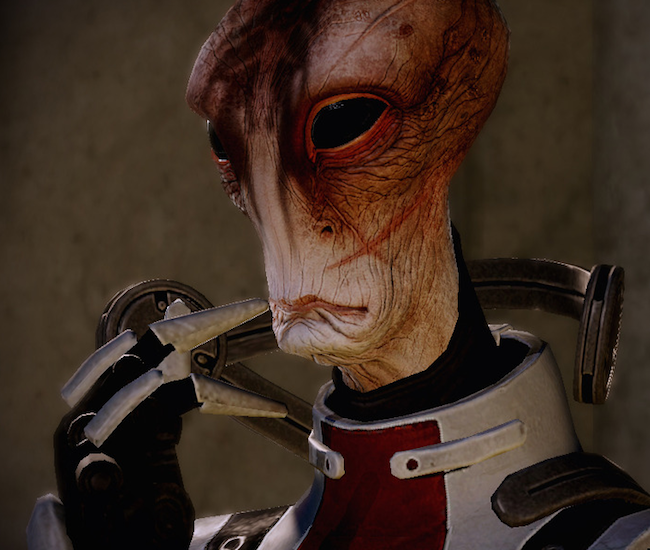
Doctor: Mordin Solus

Ok, so “Mass Effect” is basically the “Star Trek” game we never got, so this is kind of a cheat.  Oddly enough, however, the video game world is not flush with capable, traditional doctors. Mordin Solus can not only heal a broken limb, or cauterize a wound, but his interstellar work experience has given him invaluable experience into dealing with every type of galactic calamity that may arise for a variety of species, while retaining the ability to keep a calm mind not motivated by personal conflict, and instead focused on what is best for all. Combined with his ability to project fire and ice from his bare hands at will, Solus is the only sawbones I want on my video game away team.

Second in Command: Gordon Freeman

He and Solus would have both been great candidates for the number two position on the crew, but Freeman has long proved himself as not just a capable man of science (even though the one experiment we saw him in went horribly, horribly wrong), but a leader of men as well. For reasons never quite explained, Gordon Freeman is a multi-talented, never wavering killing machine that has the ability to quickly decipher a variety of on the fly brain teasing situations. Frankly, he gets it done like no other video game character. While he doesn’t have the personality to lead a crew, he’s a better second in command than anyone can hope for.

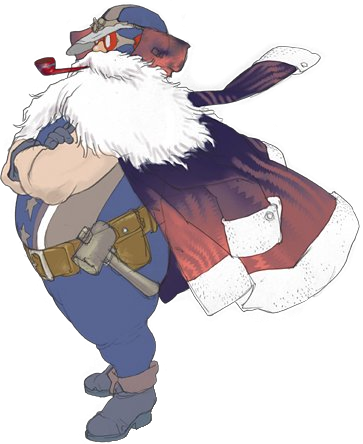
Engineer : Cid Pollendina

There’s been many variations of the Cid character, and while many of them were engineer types, and some people prefer the gruff Cid Highwind from “Final Fantasy VII,” to me the only engineer your team needs is “Final Fantasy IV’s” Cid Pellendina. He’s a little more fun loving than some of the other Cids, yet his work ethic is unwavering, and unlike Cid Highwind, you never have to worry about him falling into a bout of alcoholism, or for his nicotine withdrawals to interfere with his work. Also you can only really trust an engineer with a full beard.

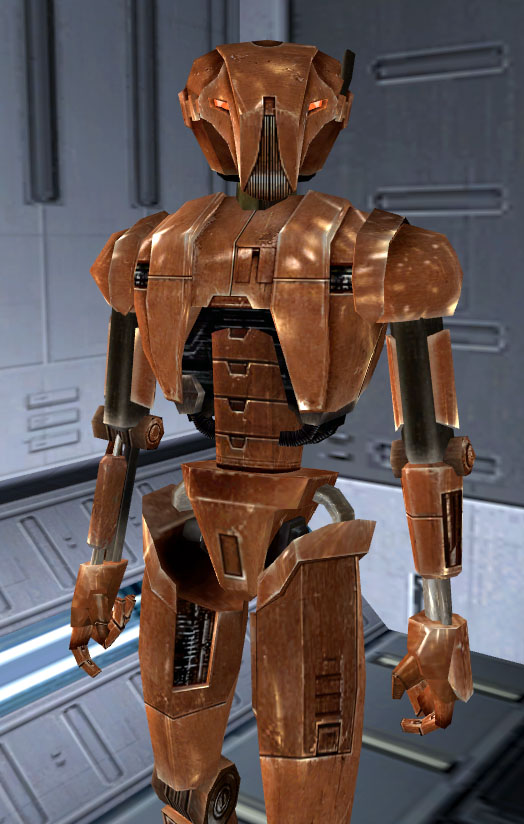
Lieutenant: HK-47

There’s a school of thought that says that a good lieutenant is always learning, fiercely loyal, and ready to step up and take charge at a moments notice. HK-47 has many of those qualities, but only if the mission is killing meatbags. Otherwise this assassin droid has a slight attitude and tendency to question orders, which can tend to discourage all but the most sociopathic of crew morale. However, sometimes you want an officer who is going to question your decisions, yet ultimately follow your final orders with machine like efficiency. HK-47 is that officer.

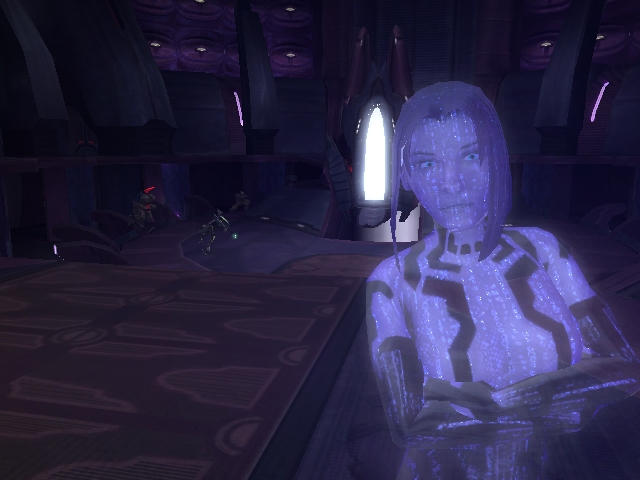
Communications: Cortana

While lacking a physical form, though you wouldn’t believe it due to some creepy fan art out there, Cortana was made for communications duties. A constant source of information, whatever Cortana doesn’t know she can learn. Plus, much like the average smartphone, she can be taken anywhere and is ready to help whenever you need it. While she has lost her virtual mind in the past, making her something of a potential loose cannon, Cortana’s otherwise high level of artificial intelligence and intense loyalty make her the only real candidate for the job.

In any case, she’s much better choice than SHODAN.

If You Need Me, I’ll Be in My Trailer

With Gamescom starting this week, the world of video games is starting to get hit with the usual tech show barrage of trailers. While I prefer good old fashioned gameplay demonstrations and hands-on previews, trailers offer a high level of entertainment value, if nothing else. However, if you pay close enough attention, you can sometimes cut past all of the stylized cuts and unnecessarily enhanced graphics to actually tell something about the game underneath.

With that in mind, here are five of the biggest trailers from the week, and what, if anything, we can take away about the games they represent from them.

Remember Me

Analysis: While I’d like to have a beer with the designers of “Remember Me,” as they’ve clearly watched “Blade Runner” and played “Deus Ex” as many time as I have, I just don’t trust Capcom as much as I used to. This is a slick debut for “Remember Me,” and cyber punk noir games will always be welcome, but it does have the misfortune of going up against the similarly themed, and soon to be released, “Dishonored.” And right now, “Dishonored” is looking better. Unless Capcom has something more in mind than the “me too” looking third person action on display in pieces here, I’m just not that excited right now. It also doesn’t help it shares a name with a Robert Pattinson movie.

Star Wars 1313

Analysis: Ok, let’s assume that Lucas Arts is obliged to churn out a new “Star Wars” game every year until the end of time. Let’s also assume that “Battlefront 3” isn’t going to happen (and believe me, it’s not). If that is the case, then I’m at least happy they are considering options in the “Star Wars” universe outside of the usual suspects of the series. However, is this a game that really needs a teaser like this? Is anyone just so jacked up for the next “Star Wars” game that a one minute and thirty-four second trailer, with about 4 seconds of gameplay in it is going to make them rush to their computer and set the hype pyre ablaze? I doubt it. At this point, until Lucas Arts has something more substantial to show, the vague chance that this game might not suck, and actually be original is the best thing they have going for them. They don’t need to ruin that with more of these generic trailers.

Crysis 3 – Multiplayer Hunter Mode

Analysis: I had zero interest in “Crysis 3” before this trailer, and now I want nothing else. This looks highly reminiscent of “Splinter Cell: Chaos Theory’s” Spy vs Merc gameplay, in that it combines two different styles of play into a unified concept. The multiplayer in that game is highly underrated and virtually unduplicated to this day, and it’s about time someone re-explored it. Also, this looks like the “Predator” game we were never going to get, which makes me more excited than I feel I can freely admit. If it can even come close to combining those two things together into a cohesive, balanced multiplayer experience, I might have to allow myself to actually use the word ‘epic.’

Tekken Tag Tournament 2

Analysis: First of all, “Can’t you tell where I must unleash this awesome power” is now going to be exactly where I tell every cab driver I’d like to go. Second, how long was he sitting in the back eerily glowing before the driver asked him where he wanted to go? Was the driver hoping he’d just disappear the next time he looked? Finally, as far as debut trailers go, if you’re going to avoid showing gameplay, this is about the best way to go. “Tekken” was always at its best when it was just having fun, and this is a fun trailer. If Namco doesn’t try to screw with the formula too much, and sticks with that loose and easy motif, I’d say the time is right for the next King of the Iron Fist Tag Tournament.

Assassin’s Creed III Naval Warfare Trailer

Analysis: As I mentioned, it’s going to take a concentrated effort for the next installment in the “Assassin’s Creed” series to suck. Ubisoft has proven they’re not scared to explore new ways to expand and improve “Assassin’s Creed,” and while the results have been mixed in some cases, I see no harm this naval gameplay could cause the franchise. Plus naval combat in this time period is rarely explored, and so far this game looks to actually be doing the idea right instead of treating the concept as an afterthought. As for the trailer itself, it features that perfect mix of style and intrigue that you expect from the series at this point, and keeps the well-oiled hype train this game is running well on track.

« Older posts Newer posts »

© 2026 Fearless Gamer

Theme by Anders NorenUp ↑